CBT for Chronic Worry
Science-Based Strategies like Worry Time

“There is only one way to happiness and that is to cease worrying about things which are beyond the power of our will.” - Epictetus
From a behavioral perspective, all anxiety disorders are maintained by avoidance. Mowrer’s Two Factor theory states that fear is acquired through classical (Pavlovian) conditioning and maintained by avoidance of feared stimuli, this being negative reinforcement from a operant conditioning perspective. This means we learn to associate inert or neutral stimuli with danger and avoid willingly facing these situations head on, so there isn’t enough opportunity for corrective learning.
Note the emphasis on willingly. For exposure to work it has to be voluntary and someone has to approach the situation with openness. If someone is “white-knuckling” an exposure, the benefits are severely limited. Keep in mind the goal is to face the feared situation and have a different emotional experience with it. Acceptance, indifference, irreverence, or even boredom are all fine options. The goal is to learn to not be afraid of being afraid.
Sometimes, people will say something like, “What about people that chronically worry, don’t they have a problem of not avoiding enough?” In fact, a number of years ago, when I was preparing a job talk for my postdoc interview (the title of which was the role of negative reinforcement in the maintenance of anxiety disorders), I had a colleague ask me that exact question. My answer then is same as it would be now.
In my clinical experience, people who tend to be chronic worriers are often people who are facing some ambiguous situations in their life and they are trying to escape the discomfort of not knowing by imagining every possible outcome. They are essentially trying to brute force their way out of uncertainty. The trouble is the more they worry, the more anxious they get. And yet the discomfort of anxious worrying, to them, is preferable to the anxiety of not knowing. Learning to tolerate uncertainty is a core step in learning to live a happy life and psychology and philosophy both have some great suggestions to pull from.
Here is how a cognitive behavioral therapist would start working with worry. The CBT approach for worry is similar to the Stoic approach of the Dichotomy of Control.
Step One: Don't tell people not to worry It's annoying and doesn't work.
Step Two: Recognize that worry isn’t inherently bad. From an evolutionary perspective, worry and rumination is probably how we learned to solve complex problems.
Chronic worriers often have difficulty tolerating uncertainty.
They over-worry/over-think as a way to try and escape the uncertainty of life.
An anxious mind tends to want to focus on the things that someone has the least control over, because that is where the most uncertainty is.
So, the goal is to shift from unproductive worry to productive problem solving. Stress and anxiety come down as productive steps are taken.
Step Three: Worry time and worry logs
Set aside 30-60 minutes each day to focus on addressing your worries. This is not easy and often requires a lot of mental redirection. Essentially you are creating a morning huddle or staff meeting for just yourself to work on addressing your worries.
People worry about forgetting what to worry about, so logging worries on a notepad or sticky function in your smart phone reduces the mental load.
Having a notepad by your bed is a good way to capture stray worries that come up when you should be sleeping.
When worries come up outside of worry time (and they will), you have to actively remind yourself that you’ll worry about that later. Write it down and focus on being mentally present in what you’re doing.
Note: Worry Time is not intended to be a cathartic exercise. The idea isn’t set aside time to worry and get it out of your system (that doesn’t work either). The idea is to learn to deal with worry in a different way that’s less exhausting and more empowering (more sustainable).
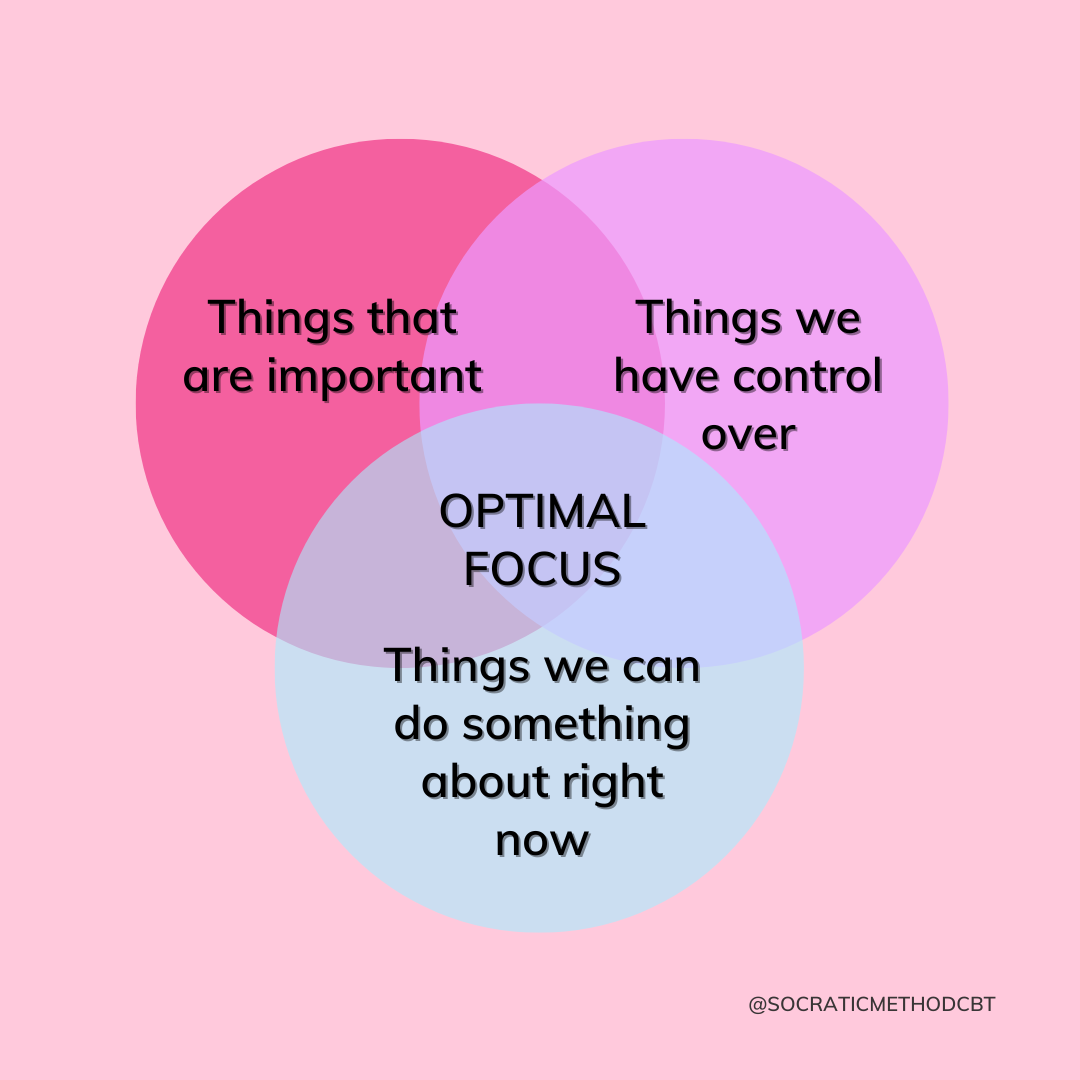
Step Four: Sort worries and plan strategies
"Never let the future disturb you. You will meet it, if you have to, with the same weapons of reason which today arm you against the present.” - Marcus Aurelius
With you most frequent worries: Are they things that you have control over? Are they things you can do something about right now?
Review worry logs to check for themes to sort into categories (individualized categories work best).
Good generic categories are things I can control and things I cannot control.
Then we want to plan a strategy for how to respond to each category. For example, we want to problem solve things we can control and deprioritize worrying about things we can’t.
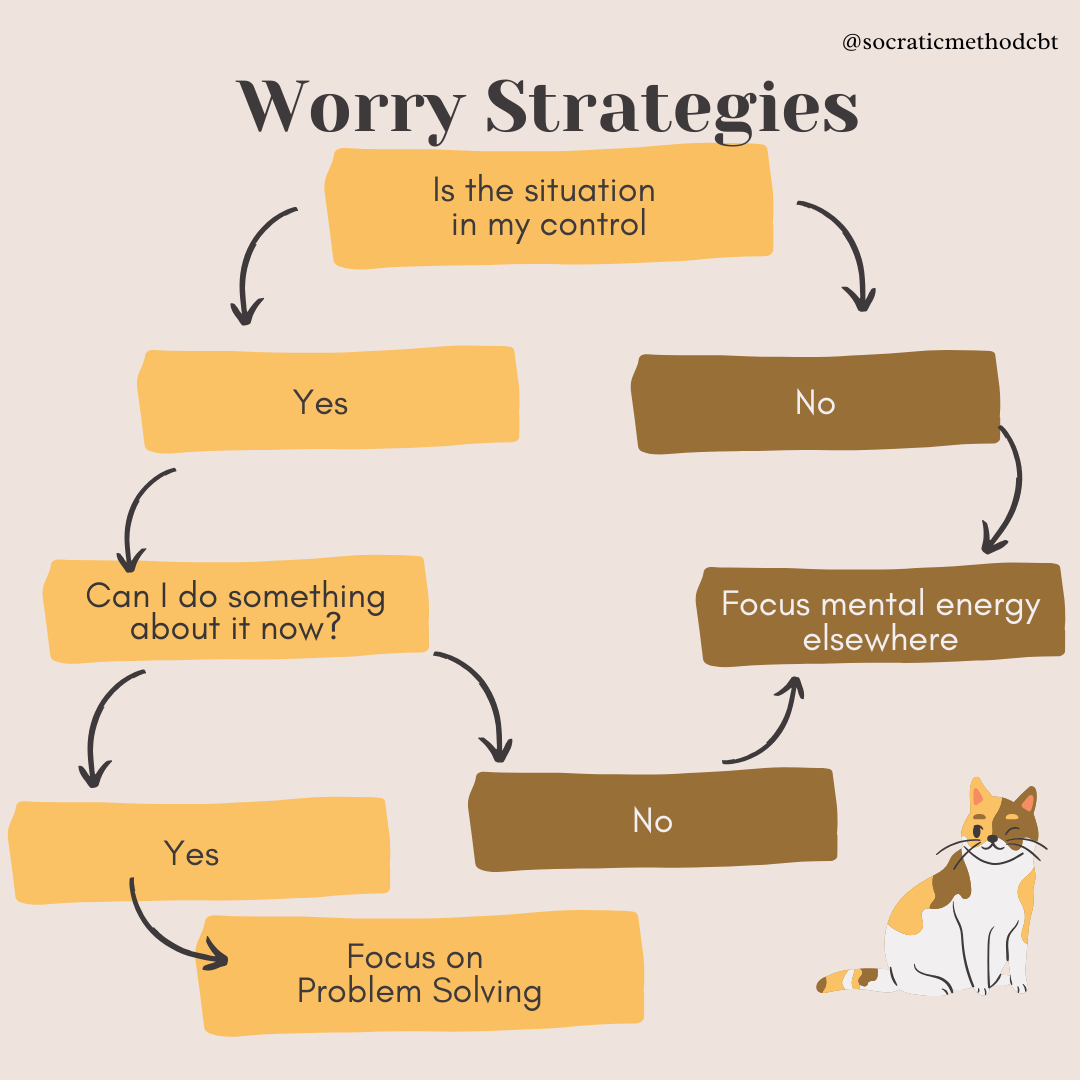
Typically, people are skeptical about whether worry time will work for them AND they still often find it to be helpful.
Increasing tolerance of the discomfort of uncertainty is often a supplemental strategy.
Learning to focus on what you have control over leads to increased self-efficacy and decreased demoralization.
Of course, there is no silver bullet.
Back to Mowrer’s Two Factor Theory. The way to weaken the association between uncertainty and danger is to learn to face it head on. If people can learn to avoid avoiding (stop worrying), they’ll learn that worrying was only giving them an illusion of control. Wisdom and piece come from understanding and accepting the dichotomy of control.
Disclaimer: This is for informational purposes and not meant to be clinical recommendations.